Coil shorted: understanding the detected short
The mod stops firing, the screen throws up a warning, and the device locks itself. Unlike other messages, this one does not report a missing part but an anomaly the electronics judge serious enough to halt everything. What it measured, and where to look, is another matter. This guide follows the reasoning of the chip through to the offending contact, and starts with what coil shorted actually says.
What coil shorted means
The coil shorted message means the chip did read the circuit connected to the 510, but that the value it obtained is abnormally low, close to zero ohms. That electrical signature is the signature of a short circuit, meaning a path by which current travels while bypassing the heating element.
British owners meet the same warning under several labels depending on the brand. Atomizer Short leads the field, and Shorted, Short Circuit or Check Atomizer turn up on other chipsets. Manufacturer support pages, Geekvape included, group the wording together with the no atomiser message because both stop the device.
The behaviour is identical whichever label appears: immediate lockout and refusal to fire while the value stays under the threshold. That lockout is not a fault, it is the protection doing its job. A near zero circuit would pull a considerable current from the cells, and the chip forbids it before anything begins.
The reasoning of the chip, step by step
The message does not appear at random. It concludes a measurement sequence identical on every press of the button, and reconstructing that sequence tells you what is genuinely at fault and, above all, what is not.
Every chipset publishes in its manual a span of resistances it agrees to fire, with a lower bound. Any value below that bound triggers the warning, whatever its origin, which produces a case few sources mention: a deliberately low build, technically sound, can trigger coil shorted on a mod whose lower bound sits above it. The device is not wrong, it is applying its own limit.
In the case of a genuine short, the current finds a metal shortcut between the positive pole and earth. That shortcut presents a near zero resistance, hence the reading. It can be plain, two parts touching, or intermittent, a leg brushing a wall and only making contact once everything is closed up. The second is far harder to locate.
The cut off happens before heating rather than during it. That is the difference with a simple power limit: the chip refuses to open the circuit rather than reduce it, which is why no setting gets round the warning. Turning the displayed wattage down changes nothing about the measured value.
Where the offending contact sits
The possible contact points are not that numerous, and they rank well. Working through them in this order avoids stripping a deck when the problem is on the connector.
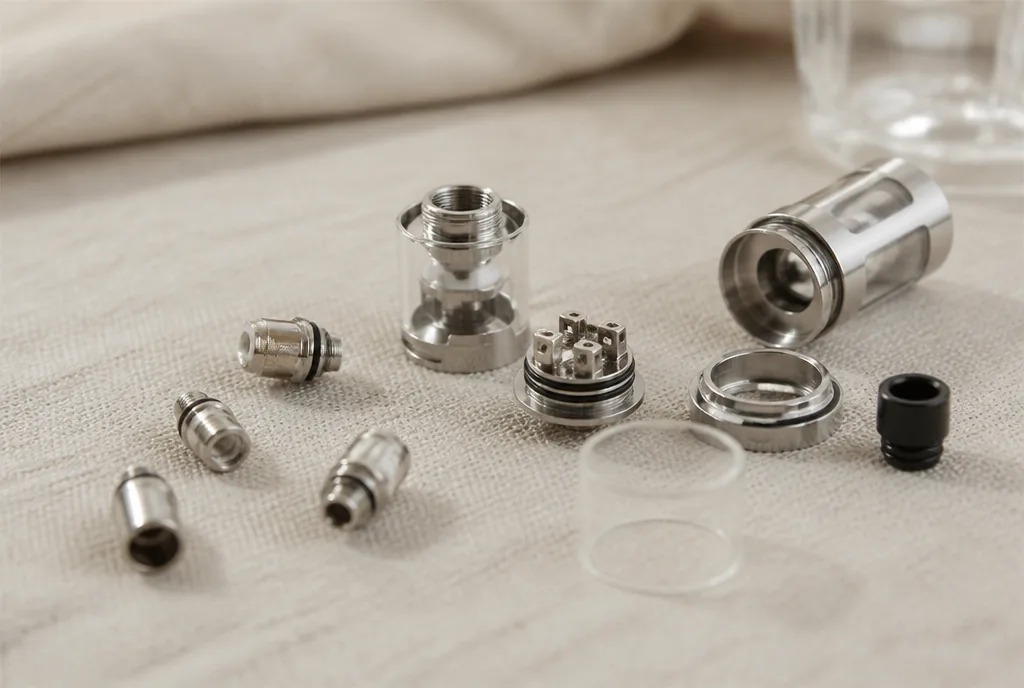
On a tank or a pod, a coil head whose metal casing has deformed brings the internal wire into contact with the body of the tank. Nothing shows from outside, and only swapping the head settles the question one way or the other.
An excess of liquid pooled in the base creates a conductive bridge between the positive pin and earth. Drying the base completely, pin included, is then enough to make the warning disappear. This is the single most common British shop counter diagnosis on a pod that has been overfilled or carried upside down in a bag.
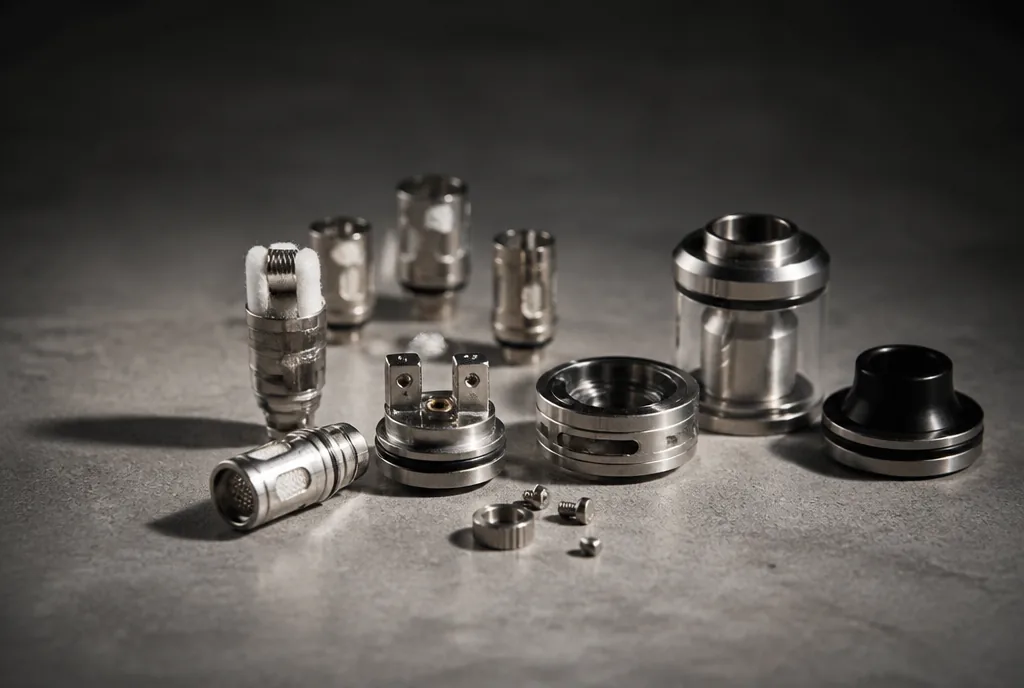
On a rebuildable, a coil leg touching the chamber wall or the body of the deck is the great classic. The consequence is immediate: current passes through the metal structure instead of crossing the wraps. A stripped lead brushing the cap once screwed down does the same, and only shows itself after full reassembly, which is why the value of a build is checked before closing it up.
The connector deserves its own look
Two faults on the 510 itself produce the identical message with no involvement from the atomiser at all, and they are worth ruling out early because the test costs nothing.
A centre pin crushed by heavy handed tightening eventually touches the thread that surrounds it. The mod then goes into protection even with nothing screwed on, which makes for a quick and risk free test. A damaged or displaced insulating ring, often disturbed during cleaning, gives the same result. That tiny part is what separates the positive pole from earth.
Cells belong in this check too, not as a cause of the message but as a separate matter of condition. Read the manufacturer datasheet for your cells rather than a shop listing, inspect the wrap and the top insulating ring before every insertion, and rewrap at the first nick. Keep loose cells in a plastic case, use them in matched pairs, and charge them on a charger built for that chemistry and format.
The method for locating a short circuit
The aim is to cut the number of suspects at each stage rather than test everything at once. Four steps cover the great majority of cases.
Remove the atomiser first and press the button with nothing attached. If the warning persists, the problem is on the mod and stripping the atomiser would be wasted effort. If everything reads normally, the top half is indeed the suspect.
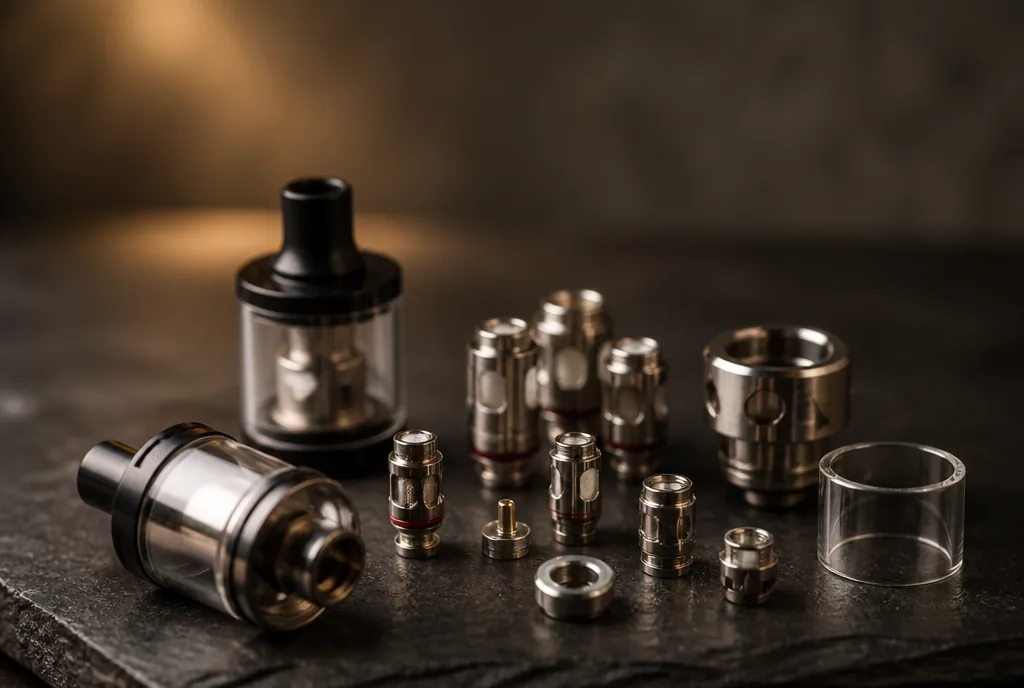
Next separate the atomiser into its parts: coil head on one side, tank body on the other. Refit the head alone onto the connector, without the tank, to find out which of the two introduces the offending contact.
On a rebuildable, take the deck apart and look at where the legs and wraps sit relative to the walls. Half a millimetre changes everything, and a coil repositioned then measured again on an ohm meter settles most cases before the cap goes back on.
Finally check that the value you are aiming for is compatible with the lower bound published in your mod manual. That piece of paperwork saves hunting for a fault that does not exist.
Short circuit or no contact: two opposite messages
These two warnings are regularly confused, and that confusion sends the diagnosis in the wrong direction every time. They describe opposite electrical situations.
With coil shorted, the measurement succeeds and returns a value that is too low: there is too much contact, somewhere there should be none. The remedy is to separate, insulate or replace the part creating the bridge.
With a no resistance message, the measurement does not succeed at all: the circuit is open and a contact is missing. The remedy is exactly the reverse, since continuity has to be restored. That case is handled in our guide to the no coil detected message, with a method of its own.
Frequently asked questions
Can the message appear with a brand new atomiser?
Yes, and it is common on cartridges still wearing their protective film or clipped in badly. Careful reassembly clears the warning in most cases.
Can a damaged cell cause it?
The message concerns the output circuit, not the cell. That said, a cell whose wrap is torn is a separate risk and justifies taking it out of service immediately.
Should you switch to an unregulated mod instead?
No. An unregulated device takes no measurement and protects against nothing, so bypassing the warning removes the very safety that has just fired.
Is cleaning with alcohol advisable?
It is common practice on metal parts, provided everything dries completely before reassembly. A damp residue reproduces exactly the conductive bridge you are hunting.
How long should you keep a mod that repeats the error?
If the warning returns with nothing screwed on, the connector is at fault and the device is worth taking to a shop rather than repairing on a kitchen table.
Handling a coil shorted without replacing kit needlessly
A coil shorted message always points to an excess of contact, never a lack of it, and that single distinction steers three quarters of diagnoses correctly. The empty test, with no atomiser fitted, separates the mod from the top half in seconds.
The rest is methodical observation: a deck can be reread, a seal repositioned, a coil head replaced. Vaping hardware copes badly with electrical guesswork, but it lets itself be diagnosed without expensive tools once you know what the machine measured, whichever of the four atomiser architectures you happen to be holding.
Editorial content for adult readers only. Vaping products usually contain nicotine, a substance that causes addiction. Not for sale to under-18s in the United Kingdom. This article is not a buying recommendation.