Vape coil wire, alloy, gauge and shape explained
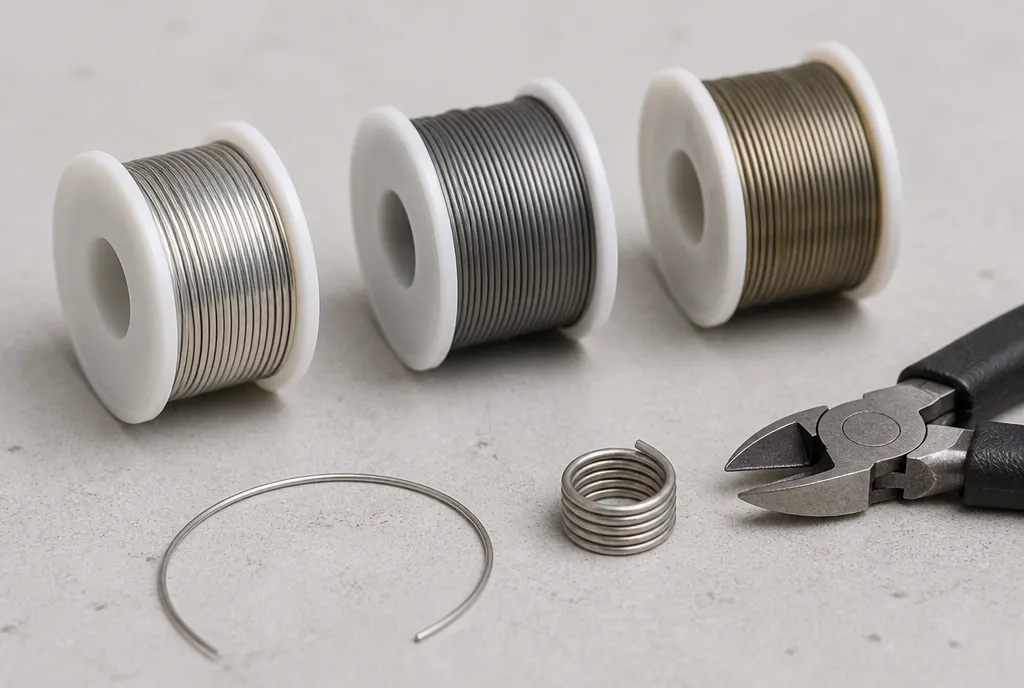
Two coils of the same diameter, wrapped around the same screwdriver, can read very differently on an ohm meter. The culprit is neither the builder’s hand nor the atomiser but the metal itself. Choosing a vape coil wire means settling three questions that shop listings tend to blur together, the alloy, the gauge and the shape. This explainer pulls them apart, using the metal makers’ own figures, to show what each choice changes once you start building.
Which vape coil wire suits which mode
The right vape coil wire depends first on the mode you run on your device. In wattage mode, Kanthal A1 and Ni80 nichrome are the two standard choices. Temperature control needs a wire whose resistance shifts clearly with heat, which means 316L stainless steel, Ni200 nickel or titanium.
316L is the only one of those three that also works in wattage mode, which makes it the most versatile wire on the bench. Ni200 and titanium, on the other hand, belong to temperature control alone. For a first build in wattage mode, Kanthal A1 remains the simplest starting point.
Three decisions behind one vape coil wire
Product listings often present a wire as a single item, a “26 ga Ni80 Clapton” for instance. That label actually combines three separate choices, and each one moves the final reading.
The alloy sets the resistivity
Resistivity describes how strongly a metal resists the flow of current. It explains why two coils that look identical do not read the same, and it also decides whether a wire can be used in temperature control.
The gauge multiplies or divides the ohms
For the same metal, a thinner wire gives more resistance per metre. Thickness is expressed in AWG, an inverted scale where the number rises as the wire gets finer.
The shape changes the mass to heat
Round wire, flat ribbon, twisted or wrapped wires all alter the surface touching the cotton and the amount of metal that has to reach temperature.
Alloys compared by resistivity
Metal manufacturers publish the resistivity of their alloys at 20 °C. Those values rarely appear in vaping guides, yet they account for most of the differences seen when building.
| Alloy | Resistivity at 20 °C | Wattage mode | Temperature control |
|---|---|---|---|
| Kanthal A1 | 1.45 Ω·mm²/m | Yes | No |
| Ni80 nichrome | 1.09 Ω·mm²/m | Yes | No |
| 316L stainless steel | about 0.74 Ω·mm²/m | Yes | Yes |
| Ni200 nickel | about 0.09 Ω·mm²/m | No | Yes |
The first two figures come from Kanthal’s datasheets for Kanthal A-1 and Nikrothal 80. The stainless steel and nickel values are averages taken from steelmakers’ and alloy suppliers’ sheets, which agree to within a few hundredths.
Kanthal A1, the wattage benchmark
Kanthal A1 is an alloy of iron, chromium (20.5 to 23.5%) and aluminium (around 5.8%). Its high resistivity reaches comfortable readings with few wraps, and its stiffness helps a coil hold its shape while you fit it.
Ni80, lower at the same length
Ni80 combines roughly 80% nickel and 20% chromium. Its resistivity is 75% of Kanthal A1’s (1.09 divided by 1.45), so an identical coil in Ni80 reads about a quarter lower. It stays a wattage-mode wire.
316L stainless steel, the dual-mode wire
With a resistivity close to half that of Kanthal, 316L needs more length for the same reading. Its resistance rises predictably as it heats, and that is what the device relies on in temperature control.
Ni200 and titanium, temperature control only
Ni200 has such a low resistivity that a wattage build would end up at unusable readings. This almost pure nickel is soft and hard to shape neatly, so wrapping it takes more care. Titanium shares the same restriction to temperature control.
What resistivity means when you cut the wire
Resistivity becomes practical once converted into ohms per metre. For a 0.40 mm wire (26 AWG), with a cross-section of 0.126 mm², the maths gives about 11.5 ohms per metre in Kanthal A1, 8.7 in Ni80, 5.9 in 316L and 0.7 in Ni200.
Aiming for 0.5 ohm on a single coil then takes about 4.3 cm of Kanthal A1, 5.8 cm of Ni80 and 8.5 cm of 316L, not counting the legs. You need roughly twice as much stainless steel as Kanthal for the same reading, which means extra wraps or a wider inner diameter.
AWG gauge, the thickness that multiplies the ohms
The gauge reads backwards. In Kanthal A1, 28 AWG measures 0.32 mm, 26 AWG 0.40 mm, 24 AWG 0.51 mm and 22 AWG 0.65 mm. Resistance follows the inverse of the diameter squared rather than a straight line.
Moving from 26 to 28 AWG in Kanthal A1 lifts the figure from 11.5 to around 18 ohms per metre, more than half again. Going the other way, 24 AWG drops to about 7.1 ohms per metre. Thin wire suits the higher readings of mouth-to-lung builds, thick wire the low readings of direct-lung builds.
Round, flat or Clapton, the shape of a vape coil wire
Once the alloy and gauge are chosen, the shape is the last call. It does not change the metal itself, but it changes how heat spreads and how fiddly the build becomes.
Round wire and flat ribbon
Round wire is the easiest to wrap and to measure. Flat ribbon offers a wider face to the cotton for a similar cross-section, but it is trickier to wrap and the turns have to sit flat against each other.
Composite wires, Clapton, fused and alien
A Clapton wraps a very fine wire around a thicker core. A fused Clapton lays two or three cores side by side under the same wrap, and an alien crimps the outer wire into waves. These builds add surface in contact with the liquid, but also mass, so they generally take longer to reach temperature than a round wire of the same reading.
They are mostly found on rebuildables with a large build deck, and especially on the dripper, the tankless atomiser that leaves room for bulky coils. In the UK, refillable tanks are capped at 2 ml, a limit that covers rebuildable tanks as well as clearomisers, whatever wire goes inside.
Measure before the first puff
A calculation gives an estimate, not a certainty. The legs, the clamping under the screws and the wire’s own tolerance shift the result by a few hundredths of an ohm, which is why every build deserves a check on an ohm meter before it goes on the device.
The reading has to stay within the range your device and battery accept. A wrap touching the deck or its neighbour makes the reading collapse, and the device flags it. Our guide to the coil shorted message walks through that diagnosis.
FAQ
The questions that come up when buying a first spool or switching alloys.
Can I use resistance wire sold for crafts or repairs?
Spools sold for heating repairs or modelling sometimes carry the same alloy name, but they are not made for this use and their labels say nothing about the finish. Wire sold specifically for vaping remains the option to choose.
Are Kanthal A1 and Kanthal D interchangeable?
Both belong to the same iron, chromium and aluminium family, but Kanthal D contains less aluminium and its resistivity drops to 1.35 Ω·mm²/m, against 1.45 for A1. A calculator set to Kanthal A1 therefore overestimates a Kanthal D build by about 7%.
Should a new coil be heated before wicking?
Some builders briefly fire a new coil without cotton, in wattage mode, to burn off manufacturing residue before wicking. That step relies on wattage mode, which rules it out from the start for wires kept to temperature control, such as Ni200 and titanium.
How long does a spool of wire last?
Spools sold in vape shops often come in lengths of 9 to 30 metres, while a single build uses only a few centimetres. One spool therefore covers a large number of rebuilds, as long as it is kept dry in its packaging.
Is mesh a type of coil wire?
Mesh is a metal grid cut into a strip rather than a wrapped wire. It is commonly made in Kanthal and 316L, and its reading depends on the same resistivity as a wire of the same alloy.
Choosing vape coil wire by mode, then by reading
A good build starts with the order of decisions. The device mode points to the alloy, the target reading points to the gauge, and the shape settles the trade-off between surface and responsiveness. The manufacturers’ resistivity figures let you estimate the length to cut before the cutters even come out.
That reasoning holds for any rebuildable, and our guide to the four atomiser architectures helps place yours. Picking the right vape coil wire is mostly about reading the metal’s datasheet as closely as the label on the spool.
Further reading
- Dripper, full anatomy of the tankless atomiser
- Coil shorted, understanding the detected short
- Vape atomiser, the four architectures explained
Editorial content for adult readers only. Nicotine is an addictive substance, and vaping products are not for sale to anyone under 18 in the UK. This article is not a buying recommendation.